
Your Cart is Empty


One family, fifty-odd years, and a long argument with several city councils. It starts with a seventeen-year-old building a guitar in his parents’ basement in 1971. Tap any moment to open it — most have photographs inside.
Ree started building guitars at his parents’ house in 1971, when he was seventeen years old. He kept at it for more than fifty years — repairing, building, buying and selling, mostly out of a basement, occasionally out of a storefront, always out of the same stubborn interest in how the things are put together.

Ree spent the 1970s working at Sounds Like This, a music store in Blue Island. The building happened at home — in the basement, first at his parents’ house and then at the place he and Daryl had of their own.
By the mid ’80s strangers were ordering from him. A lefty and a right-handed tobacco sunburst Explorer, both maple, came out of that basement weeks apart — two customers who had never met, asking the same man for the same guitar.

Ree built his son Jon a guitar in 1989, when Jon was five. That is roughly where the second half of this story starts.


The family moved to Oak Forest in 1988 and the shop moved into that basement with them. For the next decade the shop was the house. Customers came to the door. Ree raised Jon from home and built a following the slow way, one repair and one conversation at a time.
It was a house with a showroom in it.


A classmate, Travis Schwark, saw Jon play in a school project and asked for lessons. That was the first student, in the basement, before there was ever a store to teach in. He has been teaching ever since.
After more than ten years of running the shop out of the family home, the city of Oak Forest came down on a zoning technicality and put an end to it. At the time it felt like the floor going out from under the whole thing.
It turned out to be the best thing that could have happened.
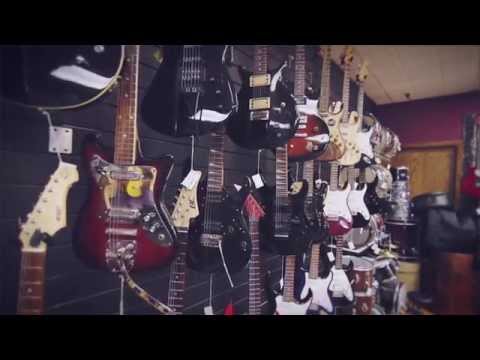
Out of the basement and into the Mid Oak Plaza in Midlothian in 1999, and the shop flourished. A real store meant walk-in traffic, a lesson room, and space to keep stock on the wall instead of in a corner of the house.

Jon became the store’s official guitar teacher at sixteen. Within a couple of years he was teaching around sixty students a week — kids, adults, beginners, people coming back to it after thirty years off.
One of them was Dave Knox. He went on to play guitar in Real Friends, formed in Tinley Park in the autumn of 2010 with Kyle Fasel, and for the last few years he has been filling in on guitar for New Found Glory, a job he is still doing on harder terms since Chad Gilbert’s death in September 2026.
Ree moved RT Guitars into a bigger space, and for a while it was good. Then the ground shifted under every independent music store at once: the big-box chains, and then the internet. The customers stayed loyal, unusually so, but loyalty does not restock a wall of guitars.
A big store you cannot afford to fill is a hard place to be. What happened next came directly out of that problem.

A coffee shop in the same plaza, much smaller than the store, put on a few bands one night and the place was mobbed. Jon, who was already playing in bands and knew the local scene, did the arithmetic: we have more room than that.
They pushed the instruments to the back, built a stage in the corner, put up a PA, and started running local shows every weekend. A guitar store that could not afford to fill its floor with inventory filled it with kids instead.
Were you there? If you played this room, stood in it, or still have a flyer in a box somewhere — email us or add it to the wall.


Standing at the back of his father’s store during those shows, Jon noticed something: a lot of the kids in the audience had bought their first guitar here. Plenty of them had taken lessons in the back room. Some of them watched a show, went home, and started a band of their own.
That is the whole idea of Evolution Music, and it was born in a corner of RT Guitars. One place that can carry you the whole way — your first guitar, your first lessons, your first show in a room full of people, and then the next room, and the bigger one after that.
Long lines of punk-looking kids outside a suburban strip mall attract attention, and not all of it the good kind. The city leaned on them. The police put a scare into Ree, who had a store to protect. Jon wanted to fight it.
Father and son fell out over it for a while. By then Jon had made too many friends in the scene and had decided this was what he wanted to do — so if the shows could not happen at the store, they would happen somewhere else.
If you played one of these shows, or stood in the crowd at one, we would love the photographs — and the story that goes with them. The photo wall further down this page takes both.
A local band that had fallen in love with RT Guitars as a venue offered to throw a benefit show to raise Jon a security deposit for a room of his own. They booked a full day of punk, metal and hardcore bands in the backyard of one of the members’ houses. By mid-afternoon the police shut it down.
Jon had already toured a space he liked, and had a landlord who was intrigued by the idea of that much foot traffic coming to his plaza. No lease, nothing signed. He called him from the shut-down show, explained that this was literally the fundraiser for the deposit on his space, and asked.
The landlord said yes. A caravan of cars full of bands and fans drove across town to a completely unlicensed empty storefront, moved the paint cans and tools out of the way, slapped the PA back up, and played the rest of the show.
That storefront became JT Music — Jon’s first venue, in Midlothian, a stone’s throw from his father’s store. All ages, which is the whole point: the fourteen-year-old who cannot get into a bar is exactly the person who needs to see a band four feet in front of them.
There were two JT Music rooms, both in the same plaza. Partway through the year the landlord wanted them in a different unit, so the room moved and carried on.
It lasted about a year before the city shut it down for being too punk rock.
Losing it sent Jon back to square one. He kept booking all-ages shows wherever a room would take them, including O’Malley’s, a bar in Alsip, and put on another benefit show at a Papa John’s in Oak Forest.
 ▶
Were you there? If you played this room, stood in it, or still have a flyer in a box somewhere — email us or add it to the wall.


In 2007 Jon took over Soundlab in Mokena — a 3,400 square foot room on West 194th Place, open since 2005, with rehearsal studios in the back and a stage big enough to mean it.
He took it on because Marcus Madel lent him the money. Marcus was eighteen, a regular at the shows who had become a good friend, and he put up the money before the room had proved anything.
And it worked. It was the most successful room Jon had run, and it brought through bands that were about to get very big.
About a year later it was shut down. For being too punk rock.
There was supposed to be a Soundlab 2.0, in a building on South Wolf Road a few minutes away. The fire department never signed off on it. One show happened in that room, and that was the whole of it.
Were you there? If you played this room, stood in it, or still have a flyer in a box somewhere — email us or add it to the wall.


Before Soundlab was finished, Jon had already taken over a shuttered venue called Sonic Portrait and renamed it The Korova, after the milk bar in A Clockwork Orange. It sat out on US Route 6 in Morris, and it opened on 23 February 2009.
Were you there? If you played this room, stood in it, or still have a flyer in a box somewhere — email us or add it to the wall.


Opened to stay close to the friends the Mokena shows had made. Through 2010 it ran a real calendar — Madina Lake, Your Demise, Rookie of the Year, The Narrative, Hundredth. It was eventually shut down too, this time because the noise bothered a neighbour.


The Lighthouse, 26 June 2010 — It Prevails and Close Your Eyes. Photographs by Eric Schander, who shot this scene for years.
Were you there? If you played this room, stood in it, or still have a flyer in a box somewhere — email us or add it to the wall.
Jon moved to the city and opened a looser, more DIY room called The Box Social, in a storefront attached to the Congress Theater. He took the space in October 2009 and ran it into 2012. The friends he made inside that building mattered more than the room itself, though the room held its own: Real Friends, Turnover and Citizen all played there one night.
None of this happened one room at a time. For much of that stretch the Box Social overlapped the Korova and the Lighthouse — a room in the city and rooms back in the south suburbs, running at once.
▶ Watch: Real Friends, Citizen, Turnover and Light Years at The Box Social, 5 August 2012 — the uploader has embedding switched off, so it opens on YouTube.
Were you there? If you played this room, stood in it, or still have a flyer in a box somewhere — email us or add it to the wall.


The first show Jon booked in the actual theatre was a ten-band showcase on his birthday. From a stage built in the corner of his dad’s guitar store to a room that held four thousand people, in not very many years. He was booking other rooms around the city in the same stretch.
The Congress ran as a concert hall until the city moved against it in April 2013 and pulled its licence that May, so this window is firmly before that.
Were you there? If you played this room, stood in it, or still have a flyer in a box somewhere — email us or add it to the wall.


Several times a year Jon put on big local-music festivals in the city — Local Music Revolution, A Not So Silent Night around Christmas, and Rocktoberfest.


Shortly after Rocktoberfest in 2011 there was finally enough money to open the first Evolution Music. Calling it a store would be generous. It was a space: barely any inventory, no reason to keep regular hours, and mostly another room to put shows in.
One room was rented out to bands to practise in — among them Real Friends and The Fight Night, who would become Rematch. Dave Skala and Matt McWilliams built a recording studio in another. The main room paid the rent by hosting shows, until the city inevitably shut that down too.
 ▶


With the industrial-park room closed for shows, Jon started putting them on at Centennial Lanes — something like the suburbs’ answer to the Fireside Bowl.
Jon booked nearly all of these — not the first Real Friends night, which he had nothing to do with, but pretty much everything after. Real Friends played there on 19 August 2011. Knuckle Puck played their first show ever at Centennial Lanes that July. Years later, once both bands were touring properly, Kyle Fasel and Dave Knox came back to run a night there called “Kyle and Dave Present a $5 Local Show.”
 ▶


Seven of the nights. There were a hundred and some more.
Were you there? If you played this room, stood in it, or still have a flyer in a box somewhere — email us or add it to the wall.
A local-music festival, booked city by city, across the country: Chicago, Lawrence, Salt Lake City, Portland, San Francisco, San Diego, Los Angeles, Denver, Memphis and Nashville. Jon and Malito, who runs the Logan Square store now, did the whole run together.
The Chicago date landed at Centennial Lanes on 8 June 2013, with Townlines, Mending Fences, Sounds Of Colour, Indy Kids, Remade Riley, The Public Divide and Beneath New Tides.


Music Go Round in Orland Park went bankrupt, closing its doors in late 2013, and auctioned off its stock. Evolution bought as much of it as it possibly could — and suddenly there was an inventory, which meant there was a reason to unlock the door at the same time every morning.
Jon’s friend Tom DeVos came in as partner and manager. That is the point where Evolution Music stopped being a room with a PA and started being a shop.
Drew Neely worked and taught at the original Evolution Music before going on to open his own lesson and recording studio. He also painted almost every store Evolution ever opened — a dear friend of this shop for as long as there has been one.


When Tom moved across the country he recruited his replacement: Mitch Gilbert, a much-loved former colleague from Music Go Round. Mitch has run the south-suburban store ever since.
Mitch turns up in most of the photographs below — he ran that store through the move and has run the south suburbs ever since.
The second store went into a garden unit in Wicker Park, which is a basement in plain English, in a space that had previously housed the offices of Pitchfork and later became Vintage Underground. A good room with a lineage.
Gerard Ortiz and Nick Miller did much of the work of making that expansion happen. Evolution Music has never been a one-man operation, whatever the rest of this page might imply — it has run on the people who showed up and ran the rooms.


The third store took over an old Masonic temple in downtown Downers Grove. It was big enough, finally, to hold the entire idea at once: instruments to buy and sell, lessons being taught, and a room to play a show in — the thing Jon had pictured standing at the back of his father’s store watching kids who had bought their first guitars there start bands of their own.
For a few years it worked exactly like that.
 ▶


The old instinct did not go anywhere. It restarted on Black Friday 2015 with an acoustic show in the Orland Park store: Belmont, Homesafe and Bonfires. Over fifty shows ran out of the Downers Grove store between 2016 and 2021, with 2017 and 2018 the busiest years by far, including Breakfest in July 2018, fifteen bands in one day. The Chicago store put them on too.
The last show in that room was an acoustic night on 30 July 2022, for Drew Neely, who died that year.
A room where you buy your first guitar should also be a room where you play your first show. That has not changed in thirty years.
Were you there? If you played this room, stood in it, or still have a flyer in a box somewhere — email us or add it to the wall.


Rock Academy, which runs group band lessons and puts kids in real bands playing real shows, merged with Evolution Music in Downers Grove. The same year the Wicker Park store moved to Logan Square, where it still is.


Evolution expanded — a store in Des Plaines, and two acquisitions much further afield: Manassas, Virginia and Mastic, New York, out on Long Island. Over the following years those all came back in: New York, then Virginia, then Des Plaines.
Jon built the Des Plaines store out with DJ Walano and Nick Miller. It opened into the middle of Covid, which is no way to start a shop, and it never got the running start it should have had.


The Orland Park store outgrew the room it started in and moved, in the second half of 2021, to a much bigger one on 159th Street.
Moving a shop full of instruments is done by the people who work there, over a few long days.
▶ Watch: Real Friends, “The Damage Is Done” — filmed in the parking lot of the second Orland Park store on 159th Street, after the stores out east.


Covid ended the concert side of it. The booking scene we had spent fifteen years building did not come back the way it was, and a business holding a lot of rooms in a lot of towns is a hard thing to hold through a year with no shows.
So the expansion came back in, and Evolution Music returned to the things that were always underneath it anyway: buying, selling and trading gear, teaching lessons, and fixing instruments. The same three things Ree was doing in a basement in 1971.
Near the end he said he was proud to have brought so much music into the world — through the guitars he built and through the store. Both of those are still out there, in houses and on stages all over this part of the country.

When it came time to move the Orland Park store in 2025, Jon felt compelled to look for a space near where it all began for him. He found one. Evolution Music in Midlothian is two doors down from where RT Guitars used to be.
Fifty-four years after a seventeen-year-old built a guitar in his parents’ basement, the family is back in the same plaza.


This is a collection of photographs of guitars Ree built or worked on over the years, and of the friends he made through music. We know some of the people in these pictures. We wish we knew more.
If you see yourself in one of these, click the photo and tell us. It takes a name, an email address and whatever you remember — a sentence is plenty. We will email you a link that lets you record the story out loud instead of typing it, add photographs of your own, and say roughly when it was, even if all you have is “sometime in the 80s.” If you recognise somebody we have not named, tell us that too.
Flyers, ticket stubs and photographs from the shows — at the store, at JT Music, Soundlab, the Korova, the Lighthouse, Centennial Lanes — are just as welcome. Most of that era only exists in other people’s phones and shoeboxes.
The wall above runs on Story Grove, which Jon also built.
Story Grove is a place for a family to keep its stories in the voices of the people who lived them. Relatives answer a question a week, by writing or by talking into their phone, and the answers gather into one archive alongside the photographs, instead of scattering across inboxes and shoeboxes. An AI biographer weaves the separate accounts into something readable while keeping each person’s own words intact, and when you are ready the whole thing prints as a hardcover book, with a QR code beside each story that plays the real recorded voice.
This page is what happens when you point it at a guitar shop instead of a family. It was built for families — but a shop turns out to be a kind of family too.
If there is somebody whose stories you would hate to lose, that is the whole idea. Have a look at Story Grove →